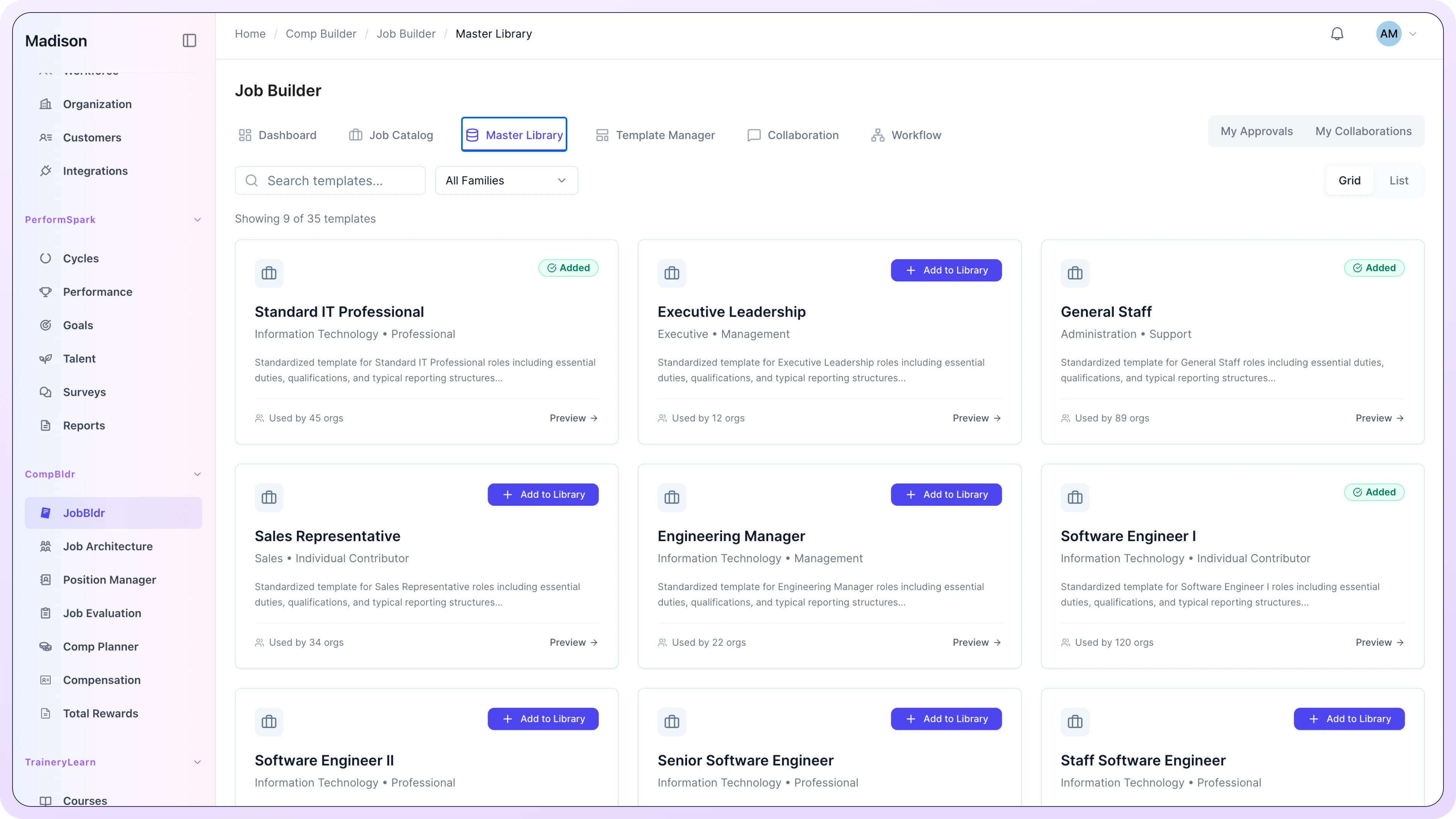
Most organizations make compensation decisions every day without governance structures or documented methodology explaining how pay is determined. CompBldr changes that by connecting job architecture, internal leveling, market benchmarking, pay analytics, and governance workflows into a single structured system.


-p-500%5B1%5D.png)
-p-500%5B1%5D.png)


-p-500%5B1%5D.png)
-p-500%5B1%5D.png)

Most pay problems aren't caused by bad intentions. They're caused by disconnected tools, inconsistent processes, and decisions made without any governance layer underneath them.
When job levels live in one spreadsheet, benchmarks in another, and approvals happen in email threads, pay decisions become inconsistent by default. There is no single source of truth. There is no way to govern what you cannot see in one place. And when an employee or an auditor asks why someone was paid a certain amount, there is no clean answer.
Without a structured job architecture and consistent leveling across your organization, pay disparities compound quietly for years. There is no moment where anyone flags the problem until it appears in an exit interview, a discrimination complaint, or a regulatory audit. By that point, the legal, cultural, and financial cost is already real and already expensive.
You pay for compensation surveys every year. But the job titles in the survey do not match your internal titles. So your team manually slots roles, spending weeks making judgment calls that introduce subjectivity at exactly the moment your process demands precision. The result is benchmarking that feels rigorous but is built on guesswork at every matching decision.
Without connected planning workflows and real-time budget visibility, individual manager approvals look reasonable in isolation. But when you add them up, the total blows the budget by 15 to 20 percent, and nobody saw it coming because nobody had a view of the full picture. HR gets blamed. Finance loses confidence in the process. And it happens again next cycle.
Six modules. One architecture. Each step feeds the next, so your compensation decisions are always built on a clean, consistent, and fully documented foundation. No more stitching together disconnected tools between cycles.


Most tools give you a place to record compensation decisions. CompBldr governs the entire decision-making process, with structure, methodology, and documentation built into every step.
Six modules. One architecture. Each step feeds the next, so your compensation decisions are always built on a clean, consistent, and fully documented foundation. No more stitching together disconnected tools between cycles.
Spreadsheets are free, familiar, and completely ungoverned.
Here is what that costs you at scale.
Your HRIS is built to store data. It is not built to govern
compensation decisions. Here is the difference.
Point solutions solve one problem well. But compensation governance
requires all the problems solved in sequence, on the same foundation.
Different roles. Different pressures. One platform that addresses all of them without compromising for any of them.
You need compensation infrastructure that is defensible to employees, executives, and regulators, not a patchwork of surveys and spreadsheets that only one person on your team can navigate. CompBldr gives HR the structure, documentation, and reporting to lead compensation strategy with confidence.
You are the person who actually builds the salary bands, runs the benchmarking analysis, and maintains the job architecture, and right now too much of that work is manual, repetitive, and prone to error. CompBldr automates the structural work so you can focus on strategy and insight rather than data wrangling.
Compensation is typically the largest controllable cost in the organization. You need live visibility into how that cost is being committed during planning cycles, not a reconciliation report after the damage is done. CompBldr gives Finance a seat at the table during every compensation cycle, not just at the end of it.
CompBldr connects to your HRIS, payroll, compensation survey providers, and finance systems so compensation governance runs on accurate, synchronized data.





Written for HR leaders, Compensation Analysts, CFOs, and anyone evaluating structured compensation management for the first time or for the second time after a first attempt that did not go as planned.
Compensation management software is a platform that structures how organizations define jobs, benchmark salaries against the external market, plan pay increases, ensure internal pay equity, and communicate total rewards to employees. If your team currently manages any part of this process in spreadsheets, disconnected survey tools, or a basic HRIS compensation module, you are operating without the governance layer that prevents pay equity issues, budget overruns, and audit exposure. CompBldr provides that governance layer, connecting job architecture through to total rewards communication in one system where each step feeds the next.

An HRIS, Workday, BambooHR, ADP, or any similar platform, is built to store and manage employee records: headcount, payroll, benefits administration, and basic compensation data. Compensation management software governs the decision-making process itself: how jobs are evaluated, how salary bands are constructed, how benchmarking data informs your pay position, how planning cycles are run with budget controls, and how every decision is documented for audit review. Most organizations run both systems together. The HRIS acts as the system of record for employee data. CompBldr acts as the system of governance for compensation decisions. Both sync bidirectionally so data stays accurate and consistent across both platforms.

Identifying and fixing pay equity issues requires three things working in sequence. First, a consistent job architecture so you are analyzing compensation across roles that are genuinely equivalent in scope, level, and responsibility. Second, reliable market benchmarking so you have an external reference for what fair pay looks like for each role and level. Third, a structured demographic analysis of your current pay data, looking at comp-ratios, range penetration, and pay outcomes by gender, ethnicity, tenure, and level to identify where systemic disparities exist.

Pay transparency laws currently active in Colorado, California, New York, Washington, Illinois, and several other states require employers to post salary ranges in job advertisements and, in some jurisdictions, disclose pay ranges to current employees upon request. Compliance is not just about posting a number. It requires that your salary ranges are defensible, consistently applied across equivalent roles, and connected to a documented job evaluation methodology that explains how the range was determined. If an employee or regulator challenges a posted range, you need to be able to show the architecture behind it.

Building salary bands that are genuinely competitive requires three inputs used in a specific sequence. First, internal job evaluation to establish the relative worth of roles within your organization so your bands reflect actual differences in scope, complexity, and contribution, not just title similarity. Second, external market data from compensation surveys to anchor those bands to what the market is actually paying for equivalent work. Third, a deliberate pay positioning strategy, your explicit decision to lead, match, or lag the market by job family, level, or geography. CompBldr handles all three in a connected workflow. You evaluate roles internally using a structured methodology, import benchmarking data from surveys like Radford, Mercer, or Willis Towers Watson, configure your pay positioning strategy, and CompBldr generates salary bands that are simultaneously market-anchored and internally consistent, not a compromise between the two.

Most CompBldr customers run their first live compensation cycle within 6 to 10 weeks of starting implementation. The process begins with your existing data even if it is currently scattered across multiple spreadsheets and structures it progressively inside the platform. You do not need a perfect job architecture or clean benchmarking data before you start. Our implementation team handles the data migration and initial configuration. Our HR consulting team is available to help you build or rationalize your job architecture as part of the implementation process. By week 7 to 10, most customers are running a real merit cycle, equity review, or compensation planning round inside CompBldr with full budget tracking, approval workflows, and audit documentation for the first time.

Most CompBldr customers run their first live compensation cycle within 6 to 10 weeks of starting implementation. The process begins with your existing data, even if it is currently scattered across multiple spreadsheets, and structures it progressively inside the platform. You do not need a perfect job architecture or clean benchmarking data before you start. Our implementation team handles the data migration and initial configuration. Our HR consulting team is available to help you build or rationalize your job architecture as part of the implementation process. By week 7 to 10, most customers are running a real merit cycle, equity review, or compensation planning round inside CompBldr with full budget tracking, approval workflows, and audit documentation for the first time.

Most compensation tools solve one part of the problem well. Radford and Mercer are compensation survey data providers, they give you market data but not the architecture to use it. Payfactors and Pave focus on salary range management and pay intelligence, useful tools that address one layer of the problem. CompBldr is an end-to-end compensation platform that connects job description creation, job architecture, job evaluation, market benchmarking, compensation planning, and total rewards communication. The defining difference is that your job architecture lives inside the platform, which means your benchmarking data maps directly to your internal role structure, your pay equity analysis is grounded in role equivalency, and every downstream decision in your compensation process inherits the same consistent foundation automatically.

CompBldr integrates with your existing HR, payroll, finance, and data systems, ensuring compensation governance operates on accurate, synchronized enterprise data.